PHARMACEUTICAL PRODUCTS

Pharmaceutical Excipients

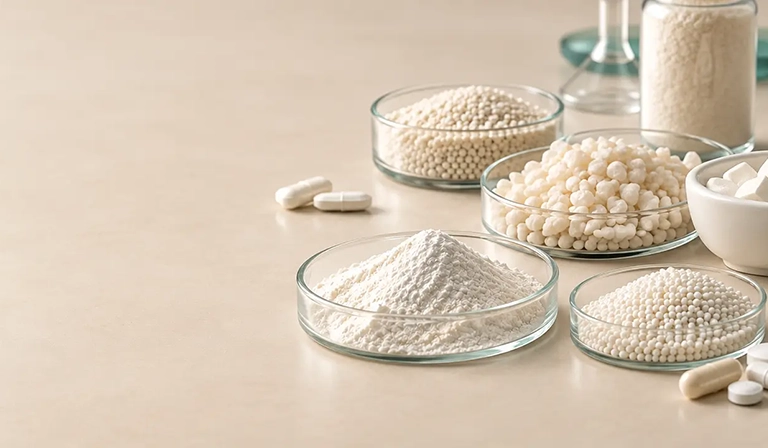
Pharmaceutical Excipients are substances used alongside active pharmaceutical ingredients in pharmaceutical formulations, supporting manufacturing, stability, physical properties, and finished dosage form performance. Shavaran sources and supplies a diverse range of pharmaceutical excipients for manufacturers according to formulation, technical, and quality requirements.
PHARMACEUTICAL PRODUCTS

Pharmaceutical Excipients

OVERVIEW
____________________

Supporting Pharmaceutical Formulation with Reliable Excipient Sourcing


Pharmaceutical excipients are substances used alongside active pharmaceutical ingredients (APIs) in pharmaceutical formulations. They support a wide range of functions related to manufacturing, stability, physical properties, and the performance of the finished dosage form. Depending on the formulation and intended application, different excipients may be used as fillers, binders, disintegrants, lubricants, glidants, coating agents, solubilizers, and other functional components.
The selection and quality of an excipient can have a significant impact on formulation performance and manufacturing consistency. Factors such as particle size, flowability, compressibility, moisture content, API compatibility, and process performance may influence the behavior of the material during manufacturing and the characteristics of the finished product.
Shavaran sources and supplies a diverse range of pharmaceutical excipients from qualified manufacturers, supporting pharmaceutical companies across different formulation and manufacturing requirements. Our range includes excipients used in various dosage forms and applications, according to the technical specifications, quality requirements, and intended use of each product.

Shavaran’s Excipient Categories

Shavaran provides access to a diverse range of pharmaceutical excipients selected to support formulation development, manufacturing processes, and the performance of finished dosage forms.

Disintegrants

____________________
Used to promote the breakup of tablets and other solid dosage forms after administration, supporting effective drug release. Key examples include Crospovidone, Croscarmellose Sodium, and Sodium Starch Glycolate.

Binders

____________________
Used to promote particle adhesion and improve the cohesion and mechanical strength of granules and tablets during manufacturing. Key examples include Povidone (PVP K30 / K90), HPMC, HPC, and Pregelatinized Starch.

Fillers / Diluents

____________________
Used to provide bulk and volume while supporting the manufacture of solid dosage forms such as tablets and capsules. Key examples include Microcrystalline Cellulose (MCC), Lactose Monohydrate, Mannitol, Sorbitol, Calcium Carbonate, Dicalcium Phosphate, and Maltodextrin.

Preservatives

____________________
Used to help protect pharmaceutical formulations against microbial growth and support product stability during storage and use. Representative examples include Methylparaben, Propylparaben, Sodium Benzoate, Potassium Sorbate, and Benzalkonium Chloride.

Coating / Solubilizing

____________________
Used to support pharmaceutical coating applications and improve the wetting, dispersion, or solubilization of formulation components. Key examples include Titanium Dioxide, PEG 400 / 4000 / 6000, Polysorbate 80, and Sodium Lauryl Sulfate.

Lubricants / Glidants

____________________
Used to improve powder flow and processing performance while reducing friction and adhesion during tablet manufacturing. Key examples include Magnesium Stearate, Calcium Stearate, Stearic Acid, Colloidal Silicon Dioxide, and Talc.

Thickeners

____________________
Used to modify viscosity and rheological properties, supporting the stability, texture, and handling of liquid and semi-solid pharmaceutical formulations. Representative examples include Hydroxypropyl Methylcellulose (HPMC), Hydroxyethyl Cellulose (HEC), Sodium Carboxymethyl Cellulose (NaCMC), Carbomer, and Xanthan Gum.

Buffers / Acidifiers

____________________
Used to control and maintain formulation pH, helping support product stability, compatibility, and performance. Representative examples include Citric Acid, Sodium Citrate, Phosphoric Acid, Sodium Phosphate, and Acetic Acid.

Sweeteners

____________________
Used to improve the taste and palatability of pharmaceutical formulations, particularly oral dosage forms. Representative examples include Sucralose, Saccharin Sodium, Aspartame, Acesulfame Potassium, and Sorbitol.

EXCIPIENT QUALITY & SUPPLY

When sourcing pharmaceutical excipients, the product name and price alone are not sufficient.
Technical specifications, pharmaceutical grade, functional properties, particle size, flowability, moisture content, API compatibility, packaging, storage conditions, and quality documentation should be evaluated according to the specific formulation and manufacturing requirements.

Impurity Profile

Purity

Pharmaceutical Grade

Quality Documentation

Packaging

Storage Conditions


Global Sourcing

Shavaran follows a Global Sourcing approach supported by an international supply network, enabling the sourcing of a diverse range of pharmaceutical excipients for companies operating in the pharmaceutical industry.
Our approach is focused on identifying suitable supply options based on the technical, formulation, quality, and sourcing requirements of each request.

Looking for a Specific Excipient?


Whether you are looking for a specific pharmaceutical excipient, need technical information, or would like to check sourcing availability, our team is ready to assist. Submit your requirements and we will respond with relevant availability, specifications, and supply options.